May 25, 2026
How to Read Cantonese Out Loud: A Beginner’s Guide to Jyutping (in Color)
If you’ve ever wanted to learn Cantonese, you’ve probably hit the same wall everyone does in the first week: how do you even pronounce this stuff? Chinese characters don’t tell you how they sound. So learners lean on romanization — a way of writing Cantonese sounds using the Latin alphabet you already know.
The best system for this is called Jyutping. Here’s how it works.
See it first: the six tones, in color
Cantonese has six tones. A “tone” is just the pitch your voice uses on a syllable — and in Cantonese, changing the pitch changes the word entirely. Same sound, different melody, different meaning.
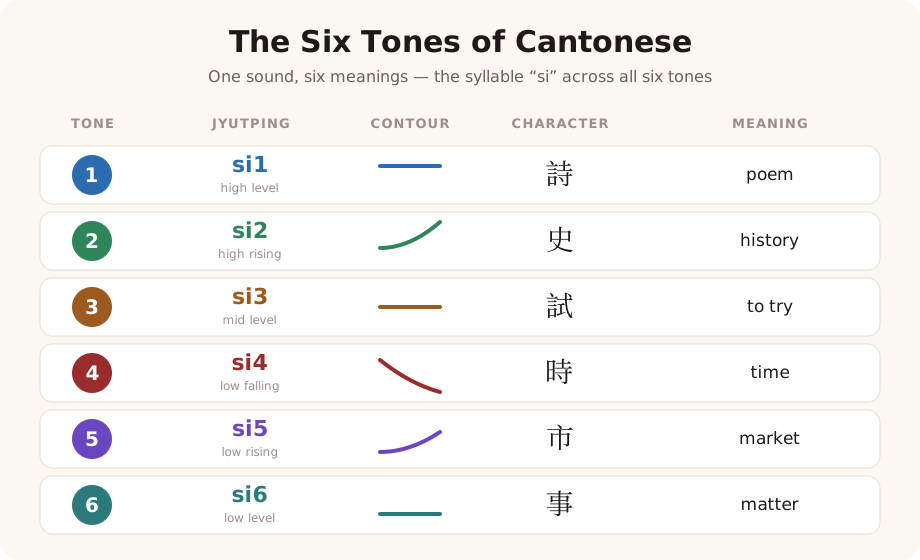
The classic way to show this is the syllable si, which means six different things depending on the tone:
Notice how each tone has a distinct pitch shape — some level, some rising, one falling. The chart above shows the syllable “si” pronounced six different ways, each with a completely different meaning.
What is a tone, really?
Here’s the part that trips up English speakers. In English, pitch carries emotion (“you’re going to the store?” rising = surprise). In Cantonese, pitch carries meaning. It’s not optional flavor — it’s part of the word, exactly like a vowel is.
The cleanest way to picture it: a tone is a tiny melody your voice traces.

Some tones stay flat (level). Some rise. One falls. Your job as a beginner isn’t to memorize abstract rules — it’s to hear the shape and copy it.
Want to feel why this matters? Watch what one tone does to a single sound:

Three identical sounds — maa — and three completely unrelated words. Get the tone wrong and you’ve called your mother a horse. This isn’t a rare edge case; it’s how the whole language works. Which is exactly why tone-first, color-coded learning matters from day one.
So what is Jyutping?
Jyutping (粵拼, literally “Cantonese spelling”) is the official romanization system created by the Linguistic Society of Hong Kong. It writes any Cantonese syllable using regular letters plus a number from 1 to 6 for the tone.
Once you see the structure, it stops looking intimidating:

That’s it. An onset (the starting consonant), a rime (the vowel and any ending), and a tone number. The number is the part beginners worry about most, but it’s actually the easiest — it’s just telling you which of the six melodies to use. goeng1 = the sounds “g-oeng” sung on tone 1. That’s “ginger.”
Why Jyutping — and not the other systems?
You’ll run into other romanizations online (Yale is the most common alternative), and well-meaning people will tell you it doesn’t matter which you pick. It does. If you’re starting today, start with Jyutping. Three reasons:
It uses numbers for tones, not diacritics and silent letters. Yale marks tones with accent marks and extra h’s scattered through the word — easy to misread, easy to drop when typing. A clean digit 1–6 is unambiguous.
It’s the modern standard. Jyutping is what Hong Kong universities, linguists, dictionaries, and input methods use. When you eventually look words up in a serious dictionary like Pleco, Jyutping is the system that’s fully supported. Learning it means you’re never re-learning later.
It’s typeable. You can write Jyutping with a normal keyboard — no special characters. That matters more than it sounds when you’re making flashcards, texting a tutor, or searching for a word at 11pm.
One quick note if you already know Mandarin: Jyutping is not Pinyin. The letters look familiar but several sound different, and Cantonese has six tones to Mandarin’s four. Treat it as a fresh system and you’ll move faster.
Where to go from here
Tones are the hardest part of Cantonese, and almost every beginner underestimates them. But they’re also the most rewarding — once your ear can tell the six tones apart, everything else in the language clicks into place.
Start with tones and listening before anything else. Find recordings of native speakers, repeat what you hear, and pay attention to the pitch shapes. Everything else in the language is easier once your ear knows what the six tones sound like.